
Concrete floor coatings for Washtenaw County homes
Epoxy Flooring in Ann Arbor, MI
Garage, basement and shop floors coated after a moisture test and a full diamond grind, priced in writing before we start.
- Free on-site estimate with a slab moisture test
- Itemized written quote before any work begins
- Full diamond grind and crack repair under every coating
What Ann Arbor Concrete Asks of a Coating
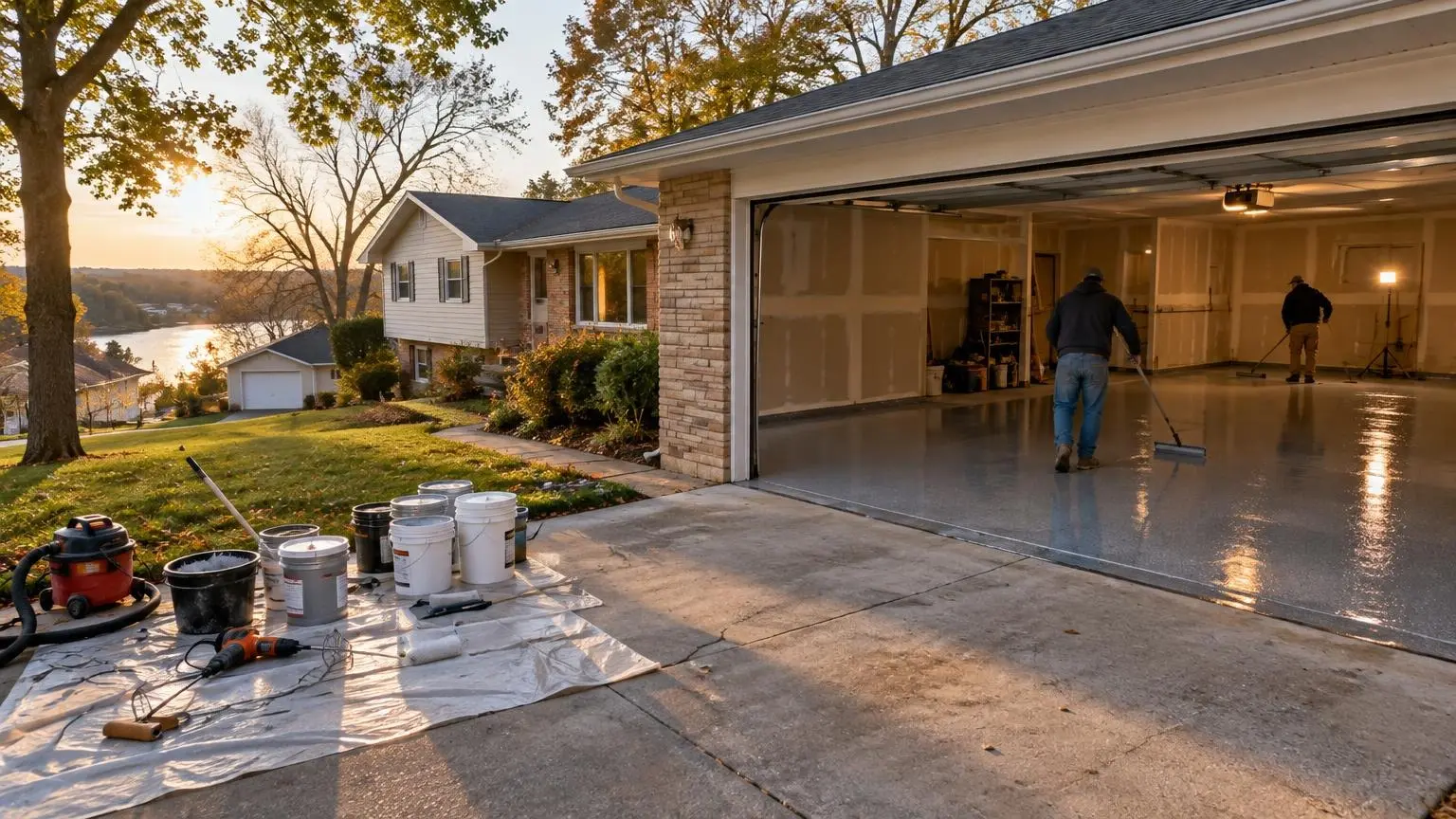
Epoxy flooring in Ann Arbor has to deal with two kinds of weather on the same slab. The University of Michigan's 1991 to 2020 climate normals, listed on Wikipedia, show about 61 inches of snow a year and more than 38 inches of total precipitation spread over roughly 166 days. In winter, your car drags salted slush into the garage. The rest of the year, ground moisture works on the basement floor from below. A coating here has to handle both, and how well it does depends on the concrete under it more than the product on top.
Salt season starts in November
The Washtenaw County Road Commission told WEMU it had spread more than 25,000 tons of salt in the 2017 to 2018 winter, a season it called historic. That salt does its job on the road and then drips off your wheel wells onto the garage floor. Brine soaks into bare concrete, and each freeze and thaw near the overhead door loosens the surface a little more. After a few winters you see a rough, flaking band across the front of the slab, chalky tire tracks and white rings where puddles dried. A sealed coating keeps that brine on the surface, where a squeegee can push it back out the door.
A city of 1960s and 1970s houses
American Community Survey figures for 2019 to 2023, summarized by Point2Homes, put the median Ann Arbor home at 1971. About a third of all housing units went up in the 1960s and 1970s, and nearly 15% were built before 1940. That mix shows up on the floors we see. There are ranch and split-level homes with attached garages poured half a century ago, older houses near downtown and the Old West Side with small detached garages, and newer townhomes toward the edges of town. A 50-year-old slab can carry old paint, a previous owner's sealer, settled sections and cracks that have been patched more than once. We check for all of it before we price the job.
Basements, sump pumps and wet soil
Plenty of Ann Arbor basements have a history with water. In 2001 the city began a footing drain disconnection program after drains tied into the sanitary sewer were linked to sewage backing up into basements in heavy rain. The Ann Arbor Chronicle reported that homes in the program had sump pumps installed in the basement. If your basement has a sump pit, an old water line on the wall or a damp corner, the slab needs a moisture test before any coating goes down.
Soil plays a part too. The USDA rates the Conover series, a loamy till soil mapped across southern Michigan, as somewhat poorly drained, with a perched seasonal water table that can sit about 6 to 18 inches below the surface. Moisture moving up through a slab is the most common reason basement coatings blister and peel.
Test for radon before you finish the basement
The Washtenaw County Health Department estimates that more than 40% of homes in the county are above the EPA's radon action level of 4.0 pCi/L, and it recommends testing every home. A coating seals the surface of a slab. It is not a radon mitigation system. If you are finishing a basement, test first. If a mitigation system goes in, we plan the floor around the suction point.
Systems we install
- Garage floor epoxy: a 100% solids base coat bonded to ground concrete, with a clear topcoat that stands up to brine and hot tires.
- Flake floors: vinyl chips broadcast into the base coat for grip underfoot and a speckled finish that hides grit between cleanings.
- Polyaspartic coatings: fast-curing coats with a wide temperature window, handy when a job falls in a cold month.
- Basement floor epoxy: moisture-tested systems with a vapor-tolerant primer when the slab needs one.
- Metallic epoxy: a poured, marbled finish for finished basements, home bars and studios.
- Shop and commercial floors: thicker builds for workshops, service bays and small business floors.
What a typical garage job includes
- Measuring the floor and checking moisture, cracks, scaling and any old coating
- Grinding the full slab with diamond tooling, edges included, and vacuuming the dust
- Filling cracks, chips and pitted areas so the finished surface is continuous
- Base coat, flake or color layer, and a clear topcoat
- A written schedule for walking on the floor, moving things back and parking
Prices in writing
We do not quote floors over the phone. Two garages of the same size can need very different prep. After the estimate visit you get a written quote listing the square footage, the prep work, each coat and the total. If something turns up once work starts, such as a hidden crack or an old coating that will not grind off cleanly, we write it up and wait for your approval.
Why Homeowners Call Ann Arbor Epoxy Flooring Pros
Every floor gets ground
We diamond grind the whole slab so the base coat bonds to clean, open concrete. Acid etching by itself leaves salt-damaged surface and old sealers in place.
Moisture tested first
Basement and slab-on-grade floors are tested before we pick a system. The reading decides the primer and the products.
Built for brine and cold
Garage floors get a chemical-resistant topcoat with texture, so meltwater stays on top and the floor has grip when wet. In cold months we check slab temperature before coating.
One written price
Your quote lists the prep, each coat, the total and how long to stay off the floor. Scope changes are written up for you to approve first.
Where We Work
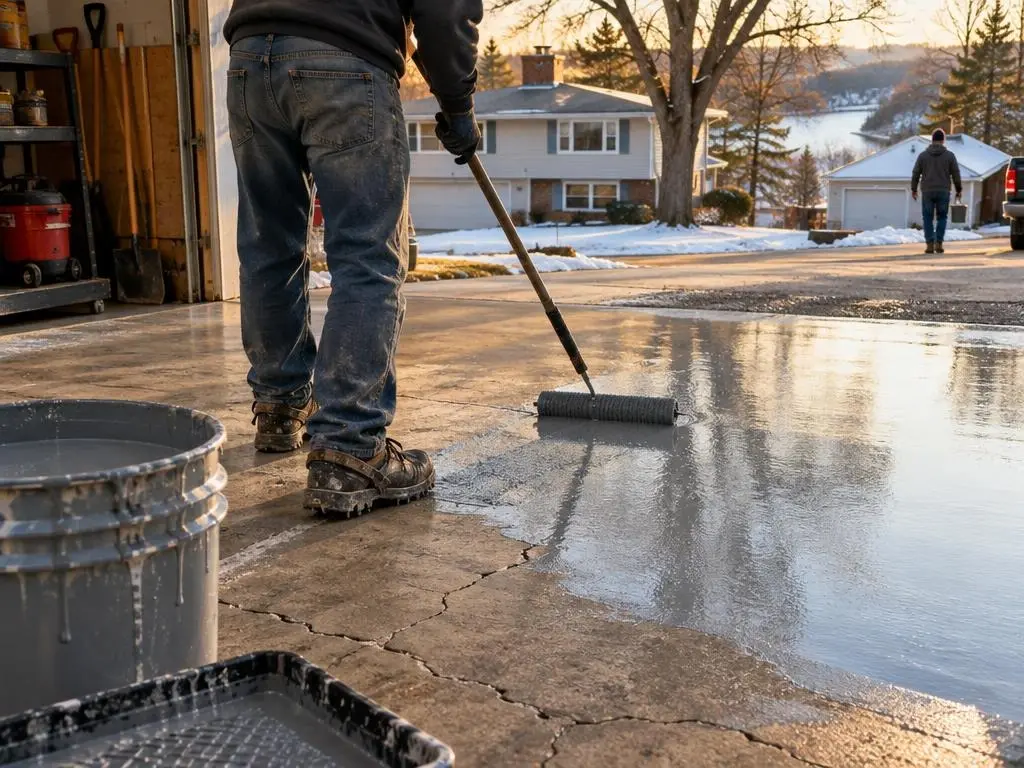
Ann Arbor is home base. We also coat floors across Washtenaw County and into Livingston and Monroe counties: Ypsilanti and Ypsilanti Township, Pittsfield, Scio, Superior and Ann Arbor townships, Saline, Dexter, Chelsea, Manchester, Milan, Whitmore Lake, Brighton, Howell, Pinckney, Hamburg, Genoa, Green Oak and Hartland townships, Monroe and Dundee. Homes vary a lot across that ground. Ypsilanti has the second-largest contiguous historic district in Michigan, with older houses and garages to match. Pittsfield and Genoa townships grew fast in the last two decades and have newer subdivisions with larger attached garages. Hamburg Township alone has 32 named lakes, and river towns along the Huron and the River Raisin sit low near the water. Each area page covers what we know about homes there.
- Epoxy Flooring in Ann Arbor, MI
- Epoxy Flooring in Ypsilanti, MI
- Epoxy Flooring in Ypsilanti Township, MI
- Epoxy Flooring in Pittsfield Township, MI
- Epoxy Flooring in Scio Township, MI
- Epoxy Flooring in Ann Arbor Township, MI
- Epoxy Flooring in Superior Township, MI
- Epoxy Flooring in Saline, MI
- Epoxy Flooring in Dexter, MI
- Epoxy Flooring in Chelsea, MI
- Epoxy Flooring in Manchester, MI
- Epoxy Flooring in Milan, MI
- Epoxy Flooring in Whitmore Lake, MI
- Epoxy Flooring in Brighton, MI
- Epoxy Flooring in Howell, MI
- Epoxy Flooring in Pinckney, MI
- Epoxy Flooring in Hamburg Township, MI
- Epoxy Flooring in Genoa Township, MI
- Epoxy Flooring in Green Oak Township, MI
- Epoxy Flooring in Hartland Township, MI
- Epoxy Flooring in Monroe, MI
- Epoxy Flooring in Dundee, MI
Our Epoxy Flooring Services
Six concrete coating services built around Ann Arbor floors: salted garages, damp basements, workshops and the finished rooms in between.
Garage Floor Epoxy
A ground, crack-filled garage slab sealed with epoxy and a tough topcoat so road brine stays on the surface.
Learn more →Epoxy Flake Floors
Colored vinyl chips broadcast into the base coat for a textured, forgiving floor that hides winter grit.
Learn more →Polyaspartic Floor Coating
Fast-curing, UV-stable coatings that can go down in colder weather and let you use the floor sooner.
Learn more →Basement Floor Epoxy
Moisture-tested basement floors with the right primer for the slab, from laundry rooms to full rec rooms.
Learn more →Metallic Epoxy Floors
Poured, marbled epoxy finishes for finished basements, bars, studios and showpiece garages.
Learn more →Shop & Commercial Floor Epoxy
Thicker coating systems for workshops, service bays, warehouses and small business floors.
Learn more →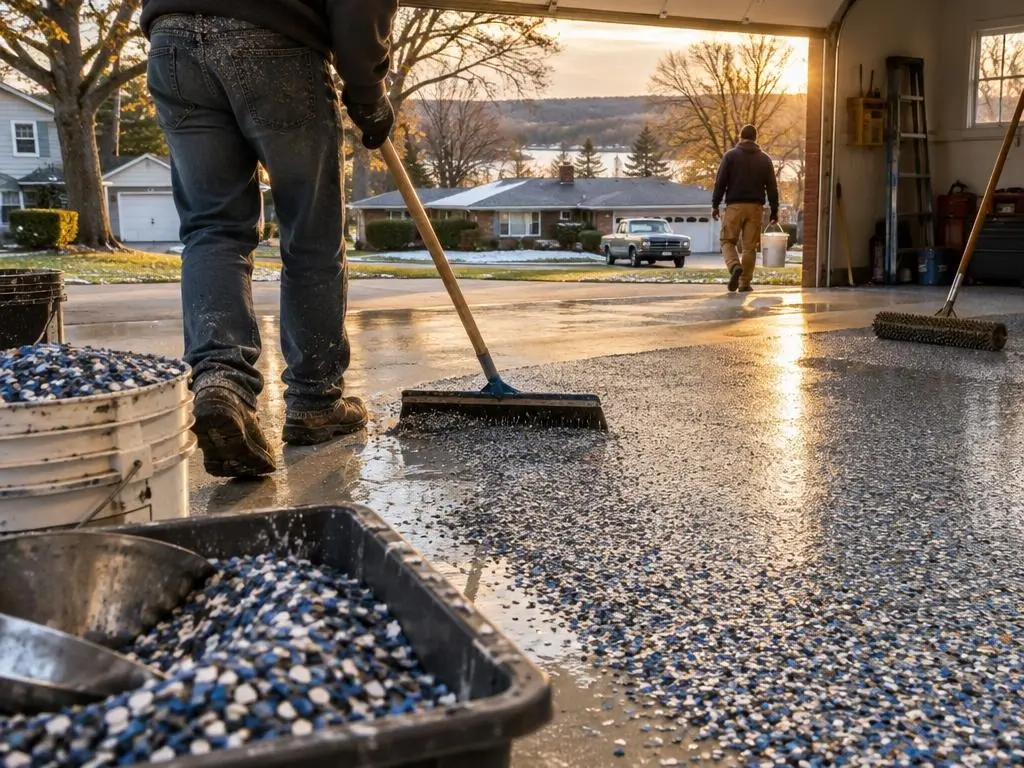
Common Questions
How much does epoxy flooring cost in Ann Arbor?
HomeGuide's national figures put installed epoxy at $4 to $10 per square foot, or about $1,600 to $5,800 for a two-car garage, and polyaspartic at $5 to $12 per square foot. HomeAdvisor lists the average epoxy floor at $2,526. Grinding off an old coating, repairing salt-scaled concrete or adding a moisture primer raises the total. We price your floor in writing after we see it.
Do home improvement stores install epoxy floors?
Large home centers mainly sell DIY kits, which HomeGuide prices at $200 to $700. Whoever applies the coating, ask how the floor will be prepared. A thin kit over an acid-etched slab often lifts at the tire paths in a salted Michigan garage, and a diamond-ground floor gives the coating far more to grip.
Can epoxy be applied to wood floors?
It is done in some craft and commercial settings, but wood swells and shrinks with the seasons and a rigid coating over it tends to crack. We coat concrete only. For a wood subfloor, another flooring material is usually the better fit.
Which epoxy brand should I choose?
The system and the prep matter more than the label. Look for a 100% solids epoxy or a polyaspartic base, a UV-stable topcoat if sunlight reaches the floor, and a moisture-tolerant primer on a damp slab. We name the exact products for your floor in the written quote.
Can you coat a garage floor during an Ann Arbor winter?
Often, yes. Resin coatings need a slab and air temperature the product can cure at. HomeGuide lists polyaspartic with an application range of -30°F to 140°F, far wider than standard epoxy, so it is a common choice in cold months. We check the slab temperature, heat the space when needed and reschedule if conditions are wrong.
Will an epoxy basement floor stop radon or water?
No. A coating seals the slab surface, but radon and water can still come in through cracks, wall joints and the sump. The Washtenaw County Health Department estimates more than 40% of county homes are above the EPA's 4.0 pCi/L action level, so test before finishing a basement, and fix water problems before any coating.
Get an Epoxy Flooring Estimate
Free on-site estimates in Ann Arbor, Washtenaw County and nearby Livingston and Monroe counties.